

Universal Pumping | High Pressure Pumps
High Pressure Pumps for Difficult to Pump Slurry, Sludge, and Food Waste.
China is a major sourcing base for bathroom fittings, but choosing a Bath Waste Push Button supplier takes more than comparing prices. The component must fit the waste assembly, operate smoothly, and resist moisture and repeated handling. Small parts matter. A button that sticks after months of use can undermine an otherwise well-made basin or bathtub.
Fortune Business Insights’ Bathroom Fixtures Market report estimated the global market at USD 87.57 billion in 2023, with a projected value of USD 129.49 billion by 2032. These figures describe the wider bathroom-fixtures market, not push-button waste products alone. That distinction matters. Broad market growth signals demand, but it does not prove that any individual manufacturer meets a buyer’s requirements. Buyers should also review product drawings, material specifications, finish options, and inspection procedures.
This guide examines Chinese manufacturers through practical sourcing questions: product range, customization, production capability, quality controls, and export experience. Ask for clear dimensions and confirm compatibility before approving samples. Check how the supplier tests button travel, drainage operation, and surface durability. A polished catalogue is useful, but it is not evidence by itself. Some public company information may be incomplete, and factory claims deserve verification. The right supplier is not necessarily the largest; it is the one that can document consistent performance and communicate clearly when specifications change.
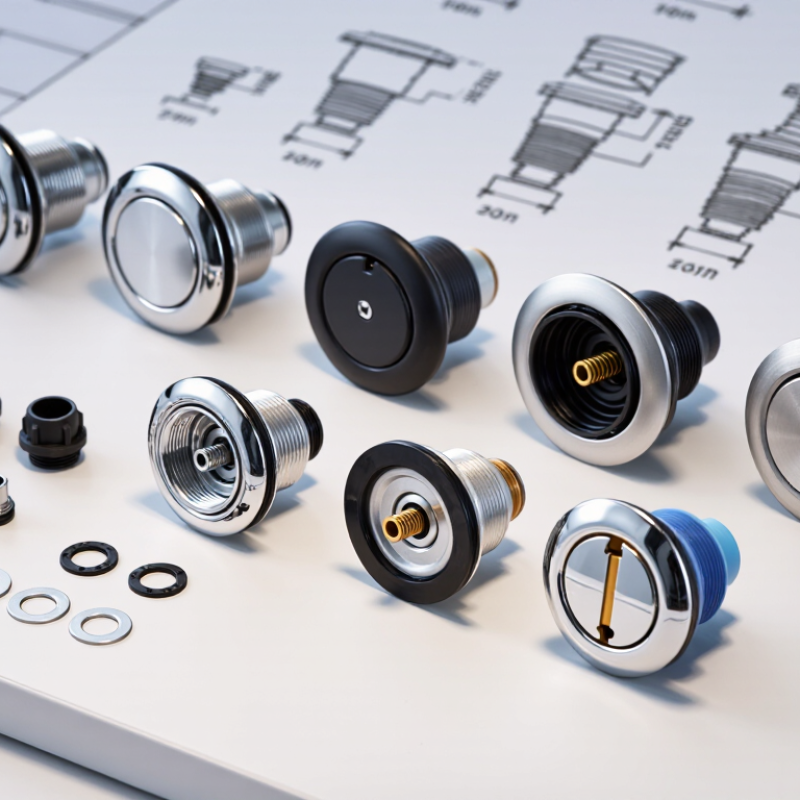
A bath waste push-button system opens and closes the tub drain through a visible button and a hidden mechanism. Pressing the button moves a linkage or cable, lifting or releasing the stopper. Designs vary: some use a cable behind the overflow plate, while others rely on a spring-loaded click-clack cartridge. The difference matters during installation. A cable can be awkward to adjust in a tight access space, while a cartridge may need periodic cleaning. Small parts matter. Hair, soap residue, and hard-water deposits can prevent a seal from closing fully.
The button itself does not control water flow. The U.S. Environmental Protection Agency’s WaterSense showerhead specification sets a maximum flow of 2.0 gallons per minute for labeled models, at least 20% below the federal 2.5-gallon standard. That figure concerns showerheads, not bath waste fittings, but it shows why drainage and water delivery should be assessed separately. For buyers comparing Chinese manufacturers, check the stopper’s sealing surface, overflow alignment, corrosion-resistant materials, and replacement-part availability. Ask for cycle-test details and leak-test procedures, not just a polished product photo. One caveat: published test results may not reflect years of household use. A smooth button is reassuring, but it is not proof of a durable seal.
| System or Specification | How It Works | Typical Application | What to Check When Evaluating a Manufacturer | Why It Matters |
|---|---|---|---|---|
| Cable-operated push-button bath waste | A control on the overflow plate operates the drain stopper through a flexible cable. | Baths where the user needs to open or close the waste from the overflow area. | Confirm cable length, routing space, actuator travel, included fittings, and the stated compatibility with the bath waste assembly. | Restricted routing or mismatched cable travel can prevent the stopper from sealing or opening correctly. |
| Push-button overflow control | Pressing the button changes the waste mechanism between open and closed positions; the internal design may vary by system. | Bath installations that use a remote control instead of reaching down to the drain. | Ask for installation instructions, adjustment guidance, replacement-part availability, and details of how the button connects to the stopper. | Clear service instructions make installation and future maintenance easier. |
| Click-clack bath waste | The user presses the stopper at the drain to alternate between open and closed positions. It is not the same as a remote overflow push-button control. | Baths where direct access to the drain stopper is practical. | Check stopper design, drain opening compatibility, cleaning access, and whether the assembly is intended for a bath with an overflow. | Distinguishing this design from a cable-operated system helps prevent ordering the wrong operating mechanism. |
| Overflow and drain compatibility | The waste assembly connects the bath drain to the outlet and, where fitted, the overflow opening. | Baths with different drain and overflow layouts. | Verify the bath’s drain and overflow positions, connection dimensions, outlet type, and the product’s stated installation limits. | Bath layouts and connection details vary; compatibility should be checked against the specific bath and installation. |
| Materials and finish options | Assemblies may use materials such as brass, stainless steel, or engineered plastics, with finishes selected for visible components. | Residential and commercial bath installations with different durability and appearance requirements. | Request a bill of materials, finish specifications, care instructions, and information about which parts are exposed to water. | Material and finish descriptions help buyers compare products without assuming that every component uses the same material. |
| Seals and water-tight connections | Gaskets and sealing surfaces help limit leakage at the drain, overflow, and connected joints. | All bath waste systems. | Check the supplied seal arrangement, installation guidance, replacement seal availability, and any applicable test documentation. | Correct assembly and suitable seals are important for reducing leaks; test claims should be supported by documentation. |
| Installation and maintenance support | Instructions describe how to position, connect, adjust, and service the waste mechanism. | Projects involving installers, distributors, or repeat product orders. | Review the instruction sheet, spare-part list, packaging details, quality-control process, and sample inspection options. | These checks help assess a supplier’s product support without relying on unsupported manufacturer rankings. |
Selection note: Dimensions, materials, finishes, and compatibility vary by product. Confirm them against the bath, installation drawing, and supplier documentation before ordering.
Universal Pumping
625 Apache Trail
Woodstock, GA 30189
Mon - Fri | 9:00 AM - 5:00 PM
Universal Pumping is staffed with industry professionals with 20-45 years experience with high pressure pumping systems. We represent only the “elite producers” in pump manufacturing: Britain’s EMS and Germany’s EMMERICH. Our engineering and manufacturing approach is conservative, and we do not use “guess work” in the design or sales of our pumping and filtration equipment.


