What Is the Best PVD Coating Equipment for Global Buyers in 2026?
Choosing the best PVD Coating Equipment in 2026 starts with the parts you actually plan to coat. A system suited to small precision components may not handle wide panels or heavy production loads. It depends. Buyers should compare chamber dimensions, fixture capacity, coating materials, and the process options offered, such as magnetron sputtering or arc deposition. The right choice also depends on the required film properties, surface finish, and acceptable cycle time. A polished brochure cannot answer every question.
Look for evidence that the equipment can produce consistent results on your own materials and part geometry. Ask suppliers for sample coatings, process data, maintenance requirements, and references from comparable applications. Check practical details too: loading access, operator training, spare-parts availability, and the service team’s response time. These affect production long after installation. Details matter. Compare total operating costs, not only the purchase price, and ask what assumptions support quoted throughput figures. If possible, review a factory acceptance test plan before placing an order. No single machine is best for every buyer. A vendor may provide strong technical specifications yet offer limited local support, or a capable system may need more floor space than expected. That is worth questioning. This guide outlines the factors global buyers can use to shortlist equipment, verify supplier claims, and select a system that fits their products, production goals, and available expertise.
What PVD Coating Equipment Does and How It Works
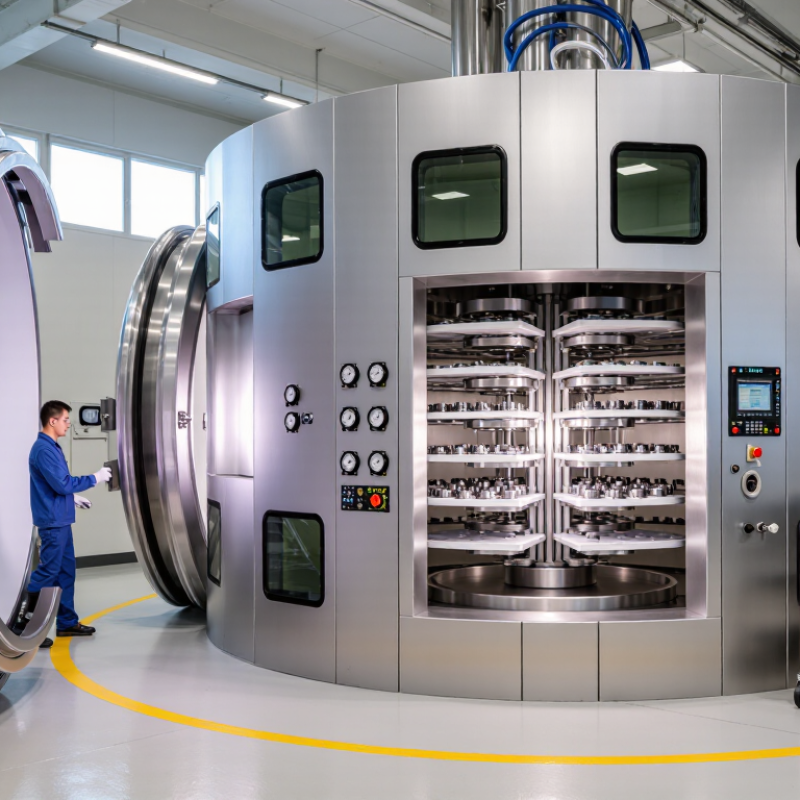
Physical vapor deposition (PVD) equipment deposits a thin film by moving material through a vacuum. A chamber first removes much of its air. The substrate is cleaned and held in a fixture. Then a source is heated or bombarded with ions, releasing atoms that travel through the chamber and condense on the part. Magnetron sputtering, evaporation, and cathodic arc are common methods. Each suits different materials, shapes, and film requirements.
The right system depends on coating uniformity, part size, throughput, and acceptable process temperature. Buyers should also check pump capacity, power controls, gas delivery, fixturing, and thickness monitoring. Reactive sputtering adds gases such as nitrogen to form compounds like nitrides. WSTS’s Autumn 2024 forecast put global semiconductor sales at $627.6 billion for 2024 and projected $697.2 billion for 2025. This signals strong demand across a sector that uses precision-coated components; it does not, by itself, prove demand for any specific PVD system. A useful reminder. A large chamber may still produce uneven films if fixtures or process settings are poorly matched.
Tips: Ask suppliers for coating results on parts shaped like yours, not only flat test coupons. Check repeatability across multiple runs. Small details count. A clean chamber and careful maintenance matter, but they cannot compensate for the wrong process.
Which PVD Technologies Suit Different Coating Applications
Choosing PVD equipment starts with the coating job, not the chamber’s headline specifications. Magnetron sputtering offers controlled, uniform films for optics, displays, and semiconductor layers, especially on complex production runs. High-power impulse magnetron sputtering can produce dense films with strong adhesion, but its lower deposition rate may limit throughput. Cathodic arc deposition suits hard, wear-resistant coatings on cutting tools. Its trade-off is possible droplets, which can affect surface finish. Thermal or electron-beam evaporation works well for many optical films, though line-of-sight coverage can leave recessed features thin. No process wins everywhere. That assumption can fail.
The application details matter. A toolmaker may prioritize hardness and repeatable batch loading; an optical supplier may need precise thickness control and low surface roughness. Semiconductor buyers often need clean, consistent films across wafers. SEMI’s June 2024 World Fab Forecast projected global semiconductor manufacturing equipment sales at $109 billion in 2024 and $128 billion in 2025. This broader investment forecast is not PVD-specific, but it signals continued demand for advanced fabrication equipment.
Tips: Ask suppliers for application-relevant trial data: coating uniformity, adhesion, defect levels, cycle time, and maintenance intervals. Test your actual part geometry. A polished coupon alone may hide shadowing or edge effects. Also compare total operating cost, not just the purchase price.
What Is the Best PVD Coating Equipment for Global Buyers in 2026?
Which PVD technologies suit different coating applications? Compare typical application suitability on a qualitative 1–5 scale, where 5 indicates a strong fit. Scores are indicative, not measured performance data; results depend on the coating material, part geometry, and process configuration.
Arc PVD is commonly suited to hard wear-resistant coatings, while magnetron sputtering is often selected for optical and large-area films. HiPIMS can provide dense coatings and is often considered for demanding tool applications.
How to Match Equipment Capacity to Production Requirements
Choosing PVD coating equipment starts with the parts, not the largest chamber on a specification sheet. Record each component’s dimensions, mass, material, and coated surface area. Then map weekly demand, shift hours, and acceptable delivery times. Small details matter. A chamber may hold many parts, yet fixtures can reduce usable space or block line of sight.
Estimate capacity using the complete cycle: loading, pump-down, deposition, cooling, and unloading. Use realistic cycle times from trials, not just the deposition time quoted in a proposal. For batch systems, calculate good parts per run after allowing for spacing and fixture limits. For frequent product changes, include cleaning and recipe setup time. A near-full schedule leaves little room for maintenance or rework. That risk is easy to miss.
Match chamber size to required output while checking whether power, pumping speed, and cooling support the chosen load. Ask suppliers for a sample run with representative parts and fixtures. Measure coating uniformity, adhesion, and thickness at defined locations. Keep a modest capacity reserve if demand fluctuates, but avoid buying volume that sits idle. Forecasts are rarely perfect.
How to Compare System Performance, Automation, and Support
Choosing PVD equipment in 2026 means comparing verified process results, not headline deposition rates. Ask suppliers to coat your actual substrate and measure thickness uniformity, film stress, adhesion, repeatability, and cycle time. A practical trial should include edge readings and a witness coupon from each run. Small variations can matter. SEMI reported global semiconductor manufacturing equipment sales of $117.1 billion in 2024, with further growth forecast. That figure reflects the wider equipment market, not PVD performance, but it underscores why buyers should demand clear, comparable acceptance tests.
Automation deserves the same scrutiny as chamber specifications. Check recipe controls, substrate handling, alarm logs, and recovery after an interrupted cycle. IFR’s World Robotics 2024 report recorded 541,302 industrial robot installations worldwide in 2023. This is a broad manufacturing indicator, not proof that a more automated PVD line will deliver better films. Request a live demonstration using your loading pattern and production recipe. Then compare operator touch time and batch-to-batch variation.
Support can decide the purchase. Confirm spare-part lead times, remote troubleshooting coverage, training hours, and local service response in writing. SEMI and IFR data provide useful context, but neither report ranks PVD systems. A polished demo is not enough; production conditions can expose gaps.
What Global Buyers Should Check Before Purchasing in 2026
Before purchasing PVD coating equipment in 2026, define the parts, materials, and production volume it must handle. A machine sized for small components may struggle with large fixtures or frequent batch changes. Ask for the usable chamber dimensions, not just the external footprint. Check which coating processes and materials the system supports, and whether recipes can be adjusted for your applications.
Specifications can look clean on paper; production rarely is. Request evidence from trials using parts similar to yours. Inspect coating thickness across different positions, adhesion results, and repeatability between runs. Ask how the supplier measures these results. A quoted pumping time is useful, but confirm it under realistic loading conditions. Small details matter. Door access, fixture changes, and cleaning time can affect output every day.
Also assess service response, spare-part availability, operator training, and installation requirements at your site. Ask for a written acceptance test with measurable targets before signing. Clarify what happens if the equipment misses them. A low purchase price can hide costly downtime, while an oversized system may leave capacity unused. It is easy to focus on cycle time and overlook maintenance; I would check both, even if the comparison feels less straightforward.