
China Top 10 Galvanized Self Drilling Screws Suppliers

Choosing a supplier for Galvanized Self Drilling Screws takes more than comparing catalog prices. Buyers should check coating thickness, drill-point geometry, steel grade, and compatibility with the base material. A screw that drills cleanly into thin sheet may struggle with heavier sections. Small differences matter.

Fastening author John H. Bickford’s work offers a useful perspective on joint design. A practical paraphrase of that guidance is: “Match the fastener to the joint, then verify the installation.” This is not a verbatim quotation. It reflects a basic point: product performance depends on both the screw and how it is used. For buyers, sample testing can reveal issues that a specification sheet may not show.

This guide to China’s top 10 suppliers provides a starting point for comparing manufacturers. It considers product range, production consistency, technical support, and the quality of available documentation. Buyers can also ask about corrosion-test methods, coating options, packaging, and inspection procedures. Request samples for the actual material and thickness in your project. Then check drilling time, thread engagement, and visible coating damage. A clean catalog is not proof of dependable production. Supplier claims still need verification.

The list cannot replace project-specific testing. Conditions vary. A coastal installation, a warehouse roof, and an indoor partition may require different coating performance and screw designs. Use the comparison to narrow your options, then confirm details directly with each supplier before ordering.
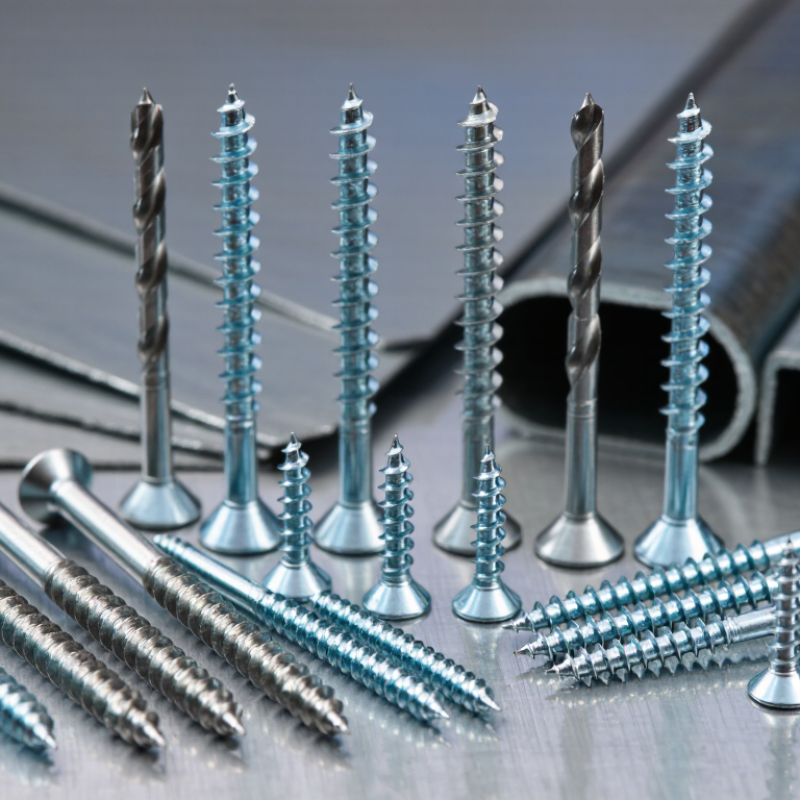
China Top 10 Galvanized Self Drilling Screws Suppliers

What Galvanized Self-Drilling Screws Are and How They Work

Galvanized self-drilling screws combine a hardened steel body with a zinc-based protective coating. Their drill-shaped points cut through thin sheet metal, while the threads follow into the material and hold the joint. No separate pilot hole is usually needed. The point is not just a sharp tip; its geometry and the steel’s thickness affect drilling performance. Too much pressure can overheat the tip, while too little may cause slipping. Small details matter.

“Galvanized” does not describe one coating thickness or process. ASTM B633/B633M, an industry plating standard, specifies zinc coating thickness classes of 5, 8, 12, and 25 micrometres. That range offers useful context, but it does not by itself predict a screw’s service life. Exposure, coating type, installation damage, and contact with other metals also influence corrosion. Check the product’s stated coating and substrate range, then test the screw on matching material when the joint is critical. A practical caution: a coated screw can still rust at a scratched drill point. Zinc helps; it is not a guarantee.

How to Evaluate Chinese Self-Drilling Screw Suppliers

China Top 10 Galvanized Self Drilling Screws Suppliers
How to Evaluate Chinese Self-Drilling Screw Suppliers

When comparing Chinese suppliers, look beyond catalogue photos and quoted prices. A dependable supplier should explain how its screws are made, coated, inspected, and packed. Ask for recent inspection records covering dimensions, coating thickness, and drilling performance. Specific answers matter.

Check whether the supplier can provide test reports and explain the test methods used. For galvanized screws, request details on coating type and corrosion testing, such as salt spray results. These results are useful, but they do not guarantee identical performance in every environment. Samples help. Test them in the material and thickness you plan to use, checking penetration, thread engagement, and head seating. A small trial can reveal issues that a polished sample photo cannot.

Also review production capacity, lead times, packaging, and how complaints are handled. Ask how defects are recorded and what happens when a batch falls outside agreed specifications. Clear answers build confidence; vague promises do not. Supplier evaluation is rarely perfect. Reports may be hard to compare, and a factory visit cannot prove every batch will be consistent. Combine document checks, sample testing, and regular communication before placing a large order.

China Top 10 Galvanized Self-Drilling Screws Suppliers - How to Evaluate Chinese Self-Drilling Screw Suppliers

A practical, brand-neutral scorecard for comparing up to 10 suppliers. The suggested weights total 100 points; assess each supplier using the same specifications and evidence requirements.

No. Evaluation Dimension Suggested Weight What to Verify Useful Evidence Score
1 Product and dimensional conformity 15 points Confirm head style, thread, point type, diameter, length, drive, and dimensional tolerances against the purchase specification. For applicable products, check relevant standards such as ISO 15480, ISO 15481, or ISO 15482. Controlled drawings, dimensional inspection reports, and samples measured against the agreed drawing and standard edition. —
2 Drilling and fastening performance 15 points Evaluate drilling time, successful penetration, thread formation, drive performance, and the risk of point breakage or head stripping in the specified base material and thickness. Application-specific test results and witnessed sample trials using the intended drill, material, thickness, and installation conditions. —
3 Zinc coating and corrosion protection 12 points Identify the coating type, coating thickness or mass where specified, post-treatment, and any restrictions for the intended environment. ISO 4042 covers electroplated fastener coatings; ISO 10683 covers non-electrolytically applied zinc-flake coatings. Coating specification, inspection results, and corrosion-test reports stating the test method, sample condition, and acceptance criteria. —
4 Material and mechanical properties 12 points Check that the material, hardness, case properties where applicable, and mechanical performance match the ordered product and its intended use. Material certificates, hardness test records, and relevant mechanical or functional test reports linked to the product lot. —
5 Quality control and traceability 12 points Review incoming-material checks, in-process controls, final inspection, nonconformance handling, and the ability to trace finished goods to production and inspection records. Quality procedures, sample inspection records, corrective-action examples, and lot-level traceability documentation. —
6 Production capacity and process control 8 points Assess whether available forming, thread-rolling, point-forming, heat-treatment, coating, and inspection processes can support the required product mix and order volume. Process flow, capacity information for the relevant product, equipment list, and production-planning approach. —
7 Customization and engineering support 7 points Check capability to review drawings, confirm application details, develop samples, and manage approved changes to dimensions, coating, or packaging. Drawing-review feedback, sample-development records, and a documented approval and change-control process. —
8 Packaging and shipment protection 6 points Confirm packaging quantity and labeling, protection against moisture and transit damage, and suitability for the receiving and storage conditions. Packaging specification, sample labels, carton details, and pre-shipment inspection records where agreed. —
9 Delivery planning and order reliability 7 points Evaluate quoted lead time, production scheduling, communication of delays, and the supplier’s ability to provide shipment documentation on time. Written production and shipping schedules, order-status updates, and delivery records for comparable orders when available. —
10 Quotation clarity and communication 6 points Compare price basis, specification coverage, tooling or sampling charges, minimum order quantities, payment terms, and response to technical questions. Itemized quotation, clearly stated assumptions and exclusions, and consistent written responses to the same inquiry. —

Scoring guidance: Enter a score for each dimension up to its suggested weight, based on documented evidence rather than claims alone. Compare suppliers against the same product specification and test conditions. Corrosion-test hours are not directly comparable unless the test method, sample preparation, coating system, and pass criteria are also stated. Confirm the applicable standard and edition for the product and market before placing an order.

Profiles of 10 Leading Galvanized Screw Suppliers in China

China’s screw-supply base reflects a broad steel-manufacturing ecosystem. World Steel Association’s World Steel in Figures 2025 reports China produced about 1,005 million tonnes of crude steel in 2024. Grand View Research estimated the global fasteners market at US$90.6 billion in 2023, with continued growth projected through 2030. These figures show scale, not supplier quality. Coating thickness, thread consistency, and test records still need checking.

The ten supplier profiles represent common specialist strengths. 1. Integrated manufacturers control wire drawing, forming, and coating. 2. Export-focused factories often provide tailored packing and documentation. 3. Roofing-screw specialists offer bonded washers and drill-point options. 4. Small-batch producers suit varied dimensions, though lead times may shift. 5. Automated high-volume plants emphasize repeatability. 6. Corrosion-control specialists provide coating specifications and salt-spray results.

7. Custom-engineering suppliers adapt head and thread geometry to substrates. 8. Regional wholesalers support mixed orders and replenishment. 9. Inspection-led factories maintain tighter sampling and traceability. 10. Value-focused producers compete on standard sizes, but their coating evidence deserves close review. Ask each candidate for material certificates, dimensional inspection records, and coating-test methods. Compare samples under the same test conditions; a shiny finish alone proves little. Some profiles overlap in practice, and that is worth admitting. A supplier’s catalogue may look precise while actual batch control remains uneven.

How the Suppliers Compare in Products and Capabilities

How the Suppliers Compare in Products and Capabilities

A useful comparison starts with screw geometry, not catalogue size. Check available diameters, lengths, head styles, drill-point ranges, and substrate thickness limits. One supplier may offer many standard combinations; another may handle custom points or tighter production tolerances. Small differences matter. A drill point that cuts cleanly through a steel panel can reduce installation time, while poor coating coverage around the point may invite early corrosion. Grand View Research estimated the global fasteners market at USD 90.31 billion in 2023, with a projected 4.5% compound annual growth rate from 2024 to 2030. This covers fasteners broadly, not galvanized self-drilling screws alone.

Manufacturing evidence separates capable suppliers from polished catalogues. Ask for lot-specific inspection records, hardness results, coating-thickness data, and confirmation that samples match production. ISO 10666 provides mechanical and performance requirements for drilling screws. For hot-dip galvanized fasteners, ASTM F2329/F2329M offers a relevant coating benchmark. Suppliers also differ in tooling flexibility, sample lead times, production capacity, and packaging suited to humid storage. Compare these details against your installation conditions. A supplier with a lower quoted price may not provide equally detailed test records. That is a real gap, not proof of poor quality. Some comparisons remain difficult because suppliers report tests differently; request comparable evidence before ranking them.

How to Choose a Supplier for Your Project

Choose a supplier by matching the screw to the real assembly, not by unit price alone. Measure the combined steel thickness and check the substrate hardness, drill-point type, and installation angle. Ask for dimensional inspection records, coating details, mechanical-property data, and lot traceability. Request certificates linked to the shipment, not a generic product sheet. Small details matter. A salt-spray result helps compare samples, but it cannot predict outdoor service life on its own. I would not treat one successful sample as proof; that shortcut is tempting, but weak.

Check whether the supplier can repeat the same quality across production batches and meet your delivery schedule. The World Steel Association’s October 2024 Short Range Outlook projected global steel demand of 1,772 million tonnes for 2025, up 1.2% from 2024. That market figure does not verify any supplier’s capacity, but it makes a useful prompt: ask about material sourcing and lead-time buffers. The NACE IMPACT study estimated annual global corrosion costs at US$2.5 trillion, or 3.4% of global GDP. It is not specific to screws, yet it shows why coating selection deserves scrutiny. For electroplated finishes, ask how the supplier addresses ISO 4042 requirements; for other zinc coatings, request the applicable specification and test method. Then install samples in your actual panels. Listen for uneven drilling. Check the finished holes. A neat certificate cannot replace that test.

Company Info

Universal Pumping

625 Apache Trail
Woodstock, GA 30189

Mon - Fri | 9:00 AM - 5:00 PM

Connect With Us

About Universal Pumping

Universal Pumping is staffed with industry professionals with 20-45 years experience with high pressure pumping systems. We represent only the “elite producers” in pump manufacturing: Britain’s EMS and Germany’s EMMERICH. Our engineering and manufacturing approach is conservative, and we do not use “guess work” in the design or sales of our pumping and filtration equipment.