What Is an IPE Beam and How Is It Used?
An IPE BEAM is a European standard hot-rolled steel section with parallel flanges and an I-shaped profile. Its geometry places steel where bending forces usually demand it, reducing weight while maintaining useful structural stiffness. Engineers commonly specify IPE sections for floor beams, roof frames, platforms, mezzanines, and industrial supports. The letters and numbers matter. “IPE 200,” for example, identifies a nominal depth of approximately 200 millimetres. Manufacturer tables then provide the exact mass, cross-sectional area, and section properties. These figures should be checked against current technical documentation.
Not every site is the same.
Selecting an IPE BEAM requires more than matching its depth to a drawing. Designers review span length, permanent loads, variable loads, deflection limits, lateral-torsional buckling, and connection behavior. Fire exposure, corrosion, lifting access, and the available steel grade also influence the final choice. A simple beam calculation is only a starting point. A beam that looks adequate may still twist, vibrate, or fail at its connection. That distinction is easy to overlook.
On site, experienced teams inspect section markings, straightness, flange edges, weld quality, and visible corrosion before installation. They also confirm dimensions against approved drawings and applicable design standards. IPE profiles are efficient, but efficiency does not mean universal suitability. A deeper section may reduce deflection, while a different profile could simplify connections or improve stability. Sound engineering balances calculation with practical judgment. The most reliable solution is the one that performs safely from fabrication through years of service.
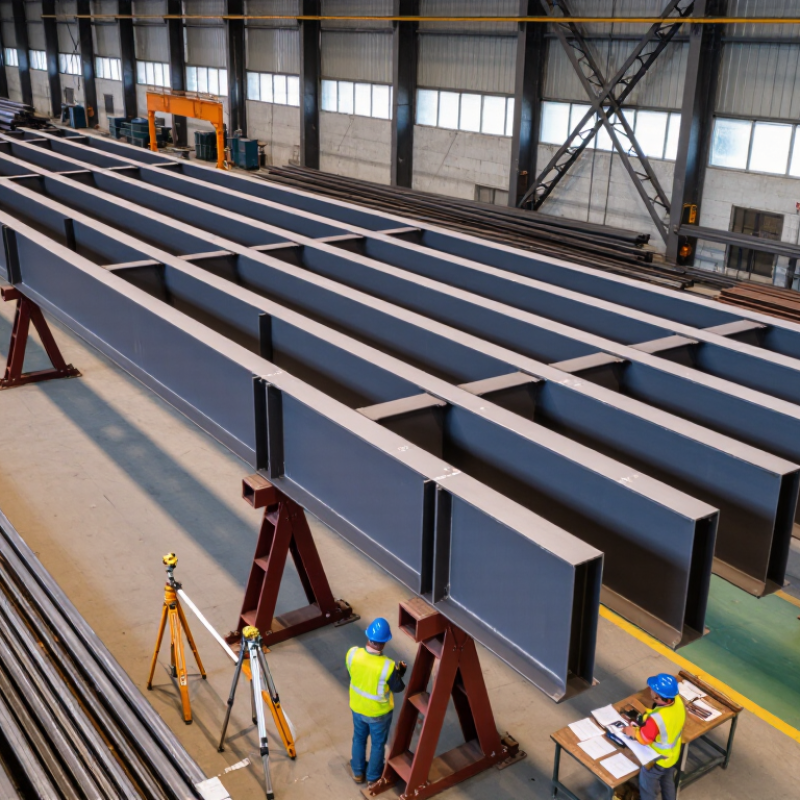
Definition and Key Features of an IPE Beam
An IPE beam is a hot-rolled structural steel section with an I-shaped profile. “IPE” refers to a European beam series with parallel inner flange surfaces. Its two flanges resist bending, while the thinner web transfers shear between them.
Key features include a relatively narrow profile, consistent dimensions, and an efficient strength-to-weight ratio. Beam designations, such as IPE 200, usually indicate the approximate section depth in millimetres. Actual dimensions and mass must come from certified section tables.
In building projects, engineers use IPE beams for floor joists, roof frames, platforms, and supporting members. Their open shape also makes connections easier to inspect and install. Still, an IPE beam is not automatically suitable for every span. Deflection, buckling, corrosion, fire exposure, and connection forces require proper engineering checks.
Tips: Confirm the exact steel grade, section size, length, and loading conditions before ordering. A quick visual match is unreliable. Check the beam table, then compare the calculated resistance with local structural requirements. During installation, keep the beam properly aligned and supported. Small alignment errors can increase twisting, especially near concentrated loads. In my experience, drawings sometimes simplify support details too much, so the site team should verify bearing length and connection positions before lifting the beam. That extra check may feel repetitive, but it prevents avoidable corrections.
How IPE Beam Dimensions and Designations Are Read
An IPE beam is a hot-rolled European I-section used for floors, roofs, frames, and industrial platforms. Its designation is practical, but easy to overtrust. In “IPE 200,” IPE identifies the section family, while 200 indicates a nominal 200-millimetre depth. It does not describe the complete beam.
Read the dimensions from a section table. The main symbols are h for overall height, b for flange width, tw for web thickness, and tf for flange thickness. Radius r and cross-sectional area A also matter. Under EN 10365:2017, an IPE 200 section is listed with h = 200 mm, b = 100 mm, tw = 5.6 mm, and tf = 8.5 mm. Its nominal mass is about 22.4 kg per metre. That number affects transport, lifting, and permanent-load calculations.
The designation is only the entry point. Engineers still check bending resistance, shear, buckling, deflection, connections, and fire conditions under EN 1993-1-1, Eurocode 3. A deeper beam usually improves stiffness, yet it may create clearance problems around ducts or doors. Real projects punish assumptions. A quick table reading can also miss steel grade and tolerances. Check the mill certificate, design drawings, and the applicable national annex before ordering or detailing the section.
Materials and Manufacturing Process of IPE Beams
What Is an IPE Beam and How Is It Used?
IPE beams are European I-section steel members with parallel flanges. Their shape places material far from the neutral axis, improving bending efficiency. They commonly support floors, roofs, platforms, and transfer structures. The material choice matters as much as the geometry. Structural grades such as S235, S275, and S355 are specified under EN 10025, with strength and weldability varying by grade.
Manufacturing usually begins with iron ore, recycled steel, or both. World Steel Association data recorded about 1.892 billion tonnes of crude steel production worldwide in 2023. Producers melt and refine the charge in basic oxygen or electric arc furnaces. The molten steel is cast into billets or slabs, then reheated before passing through shaped rollers. Several rolling passes form the web and parallel flanges. Controlled cooling follows. Straightening removes curvature, although small residual stresses can remain.
Not perfectly uniform.
Quality teams check dimensions, surface condition, chemical composition, and mechanical properties. EN 10365 defines key IPE dimensions and tolerances, helping engineers coordinate drawings with mill output. Ultrasonic testing may reveal internal discontinuities, while tensile tests verify strength and elongation. In real projects, moisture, poor storage, or rough handling can damage otherwise compliant sections. That detail is easy to underestimate. Engineers should also verify beam length, connection design, fire protection, and actual loading conditions before installation.
What Is an IPE Beam and How Is It Used?
IPE beams are European standard I-shaped structural sections with parallel flanges. They are commonly used for floor beams, roof supports, columns, frames, and other load-bearing applications. The chart shows the nominal mass per metre for selected IPE sizes.
Nominal mass values are based on standard IPE section dimensions specified in EN 10365. IPE beams are typically manufactured from structural carbon steel such as S235, S275, or S355 by hot rolling, followed by straightening, cutting, inspection, and surface treatment where required.
Common Structural Applications of IPE Beams
IPE beams are European I-section steel members standardized under EN 10365. Their parallel flanges make connections simpler and improve load transfer. Engineers commonly use them as floor beams, roof purlins, lintels, and secondary supports in industrial buildings.
In a warehouse, an IPE beam may carry concrete decking, service loads, and partition walls. In a small commercial project, it can support an opening between masonry walls. Bridges and platforms also use IPE sections when moderate spans and predictable loads are required.
The World Steel Association reported approximately 1.9 billion tonnes of crude steel production worldwide in 2023. This scale supports broad availability, but availability does not replace design judgment.
Eurocode 3, EN 1993-1-1, requires checks for bending, shear, buckling, and serviceability. A beam can look oversized and still deflect too much. That mistake is easy to underestimate.
Tips:
Check the span, load path, restraint, and connection details together. Compare the selected section with EN 10365 dimensions and project-specific Eurocode requirements. Allow room for fire protection and corrosion control. Site measurements can also expose uncomfortable errors; drawings are not always perfect. In practice, a slightly heavier IPE section may simplify installation, but it can increase lifting demands and connection costs. Ask a qualified structural engineer to verify the final design.
Advantages and Selection Considerations for IPE Beams
An IPE beam is an I-shaped European structural section used to carry bending loads. Its narrow flanges and deep web provide efficient strength with relatively low weight. In building frames, IPE beams commonly support floors, roofs, platforms, and secondary steelwork. Their familiar profile also makes connections and fabrication more predictable.
The main advantage is material efficiency. The beam resists bending effectively while reducing unnecessary steel in many applications. Its open shape can simplify service coordination, but it may need fire protection or lateral restraint. Selection depends on span, loading, deflection limits, connection details, and available installation space. Engineers should check both strength and serviceability under applicable design standards. A larger beam is not automatically safer. It can increase cost, connection forces, and handling difficulty. Real projects often expose this mistake.
Tips: Confirm the design load before choosing a section. Check beam stability, especially when compression flanges lack restraint. Compare deflection limits with the floor or roof finish. Measure connection zones carefully; a theoretically suitable beam may not fit the actual joint. Review corrosion exposure and fire requirements early. A quick table helps, but it cannot replace structural calculations. Even experienced teams should revisit assumptions when spans, supports, or loads change.
What Is an IPE Beam and How Is It Used? - Advantages and Selection Considerations for IPE Beams
| IPE Section | Overall Depth
h (mm) | Flange Width
b (mm) | Web Thickness
tw (mm) | Flange Thickness
tf (mm) | Mass
(kg/m) | Area
(cm²) | Major-Axis
Iy (cm⁴) | Major-Axis
Wel,y (cm³) | Minor-Axis
Iz (cm⁴) | Typical Use |
| IPE 80 | 80 | 46 | 3.8 | 5.2 | 6.0 | 7.64 | 80.1 | 20.0 | 6.68 | Light-duty framing, bracing, and small secondary supports |
| IPE 100 | 100 | 55 | 4.1 | 5.7 | 8.1 | 10.3 | 171 | 34.2 | 12.2 | Light floor members and architectural steelwork |
| IPE 120 | 120 | 64 | 4.4 | 6.3 | 10.4 | 13.2 | 318 | 53.0 | 27.7 | Secondary beams, platforms, and moderate-span framing |
| IPE 140 | 140 | 73 | 4.7 | 6.9 | 12.9 | 16.4 | 541 | 77.3 | 44.9 | Floor beams and light industrial structures |
| IPE 160 | 160 | 82 | 5.0 | 7.4 | 15.8 | 20.1 | 869 | 109 | 68.3 | General building beams and mezzanine framing |
| IPE 180 | 180 | 91 | 5.3 | 8.0 | 18.8 | 23.9 | 1317 | 146 | 101 | Longer floor spans and moderately loaded roof members |
| IPE 200 | 200 | 100 | 5.6 | 8.5 | 22.4 | 28.5 | 1943 | 194 | 142 | Primary floor beams, roof beams, and transfer members |
| IPE 220 | 220 | 110 | 5.9 | 9.2 | 26.2 | 33.4 | 2772 | 252 | 205 | Heavier building frames and industrial support beams |
| IPE 240 | 240 | 120 | 6.2 | 9.8 | 30.7 | 39.1 | 3892 | 324 | 284 | Long-span beams and heavily loaded platforms |
| IPE 270 | 270 | 135 | 6.6 | 10.2 | 36.1 | 45.9 | 5790 | 429 | 420 | Heavy roof, floor, and industrial framing |
| IPE 300 | 300 | 150 | 7.1 | 10.7 | 42.2 | 53.8 | 8356 | 557 | 604 | High-load primary beams and long-span structural framing |
Selection considerations: Choose an IPE section by checking bending resistance, shear resistance, deflection limits, lateral-torsional buckling, connection details, fire exposure, corrosion conditions, available installation space, and design loads. The major-axis properties govern typical beam bending, while the minor-axis properties are important for lateral stability and column applications.
Nominal geometric and mass values are based on the European IPE profile series specified in EN 10365. Values are suitable for preliminary comparison; final member selection should be verified using the applicable structural design standard and project load combinations.