

Universal Pumping | High Pressure Pumps
High Pressure Pumps for Difficult to Pump Slurry, Sludge, and Food Waste.
What Are the Top 10 Types of Liquid Ring Vacuum Pumps? This question sounds simple, but the answer depends on operating conditions. A chemical plant may need corrosion resistance. A paper mill may prioritize continuous water handling. A food processor may require clean, stable suction.
A Liquid Ring Vacuum Pump uses a rotating impeller and a sealing liquid. The liquid forms a moving ring inside the casing. This design can tolerate moisture, vapor, and small liquid carryover. It is not perfect. Its performance changes with liquid temperature, seal-water pressure, gas composition, and altitude.
John F. O’Hanlon, author of A User’s Guide to Vacuum Technology, emphasizes a practical principle: “The ultimate pressure is not the only criterion for judging a vacuum system.” That warning fits liquid ring equipment well. A pump reaching a lower pressure may still perform poorly with hot water or heavy vapor loads.
This guide compares ten important types and configurations. They include single-stage, two-stage, conical, stainless-steel, oil-free, and compressor-capable designs. Some categories overlap. That is normal in industrial engineering.
The comparison will examine vacuum range, capacity, liquid compatibility, energy demand, maintenance, and typical applications. It will also identify trade-offs often hidden in product brochures. A pump may look efficient on paper, yet lose capacity when seal water warms by only a few degrees.
Real selection requires more than a catalog number. It requires measured gas loads, process temperatures, and honest maintenance expectations. Mistakes happen. Good engineering makes them visible early.
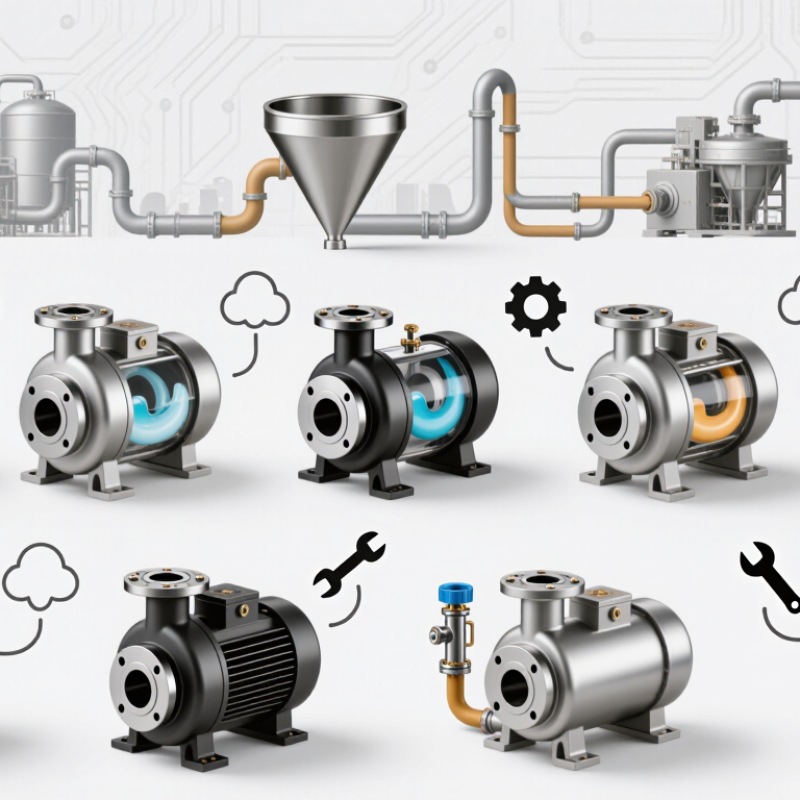
What Are the Top 10 Types of Liquid Ring Vacuum Pumps?
Liquid ring vacuum pumps are classified by sealing liquid, stages, installation, and drive arrangement. The ten common types include single-stage, two-stage, water-sealed, oil-sealed, closed-loop, once-through, horizontal, vertical, direct-drive, and belt-driven pumps. Single-stage units suit moderate vacuum duties, while two-stage designs reach deeper vacuum levels. Water-sealed pumps are common in chemical processing, paper production, and filtration. Oil-sealed versions can reduce vapor contamination, but oil management becomes critical.
The classification should begin with the required suction pressure, gas composition, temperature, and liquid compatibility. A pump handling solvent vapor needs stronger materials and controlled seal-liquid temperature. In field testing, a warm seal liquid can noticeably reduce capacity. Small details matter. The U.S. Department of Energy reports that pumping systems may consume about 25% of industrial electricity, although vacuum applications vary widely. Market assessments published by Grand View Research also identify energy efficiency as a major development factor in vacuum equipment through 2030. These figures are useful, but not perfect for every plant.
Closed-loop systems often reduce water consumption by recirculating the seal liquid. Once-through systems may be simpler, yet they can create higher operating costs. Horizontal installation usually simplifies maintenance, while vertical units save floor space. Direct drives reduce alignment work. Belt drives may offer easier speed adjustment, but they require inspection. Engineers should verify performance against actual vapor loads, not only catalogue curves. I have seen classifications become misleading when operators ignore liquid temperature and non-condensable gas content.
| No. | Pump Type | Primary Classification Basis | Typical Ultimate Pressure1 | Liquid Arrangement | Main Characteristics | Typical Applications |
|---|---|---|---|---|---|---|
| 1 | Single-Stage Liquid Ring Pump | One compression stage | Approximately 80–100 mbar absolute with water at suitable temperature | One liquid ring surrounding an eccentric impeller | Simple construction, strong liquid-handling capability, and good tolerance for condensable vapors | Priming, filtration, vacuum dewatering, packaging, and general process vacuum |
| 2 | Two-Stage Liquid Ring Pump | Two compression stages in series | Approximately 30–40 mbar absolute with water at suitable temperature | Two impeller stages connected internally or through an interstage passage | Achieves deeper vacuum than a single-stage design while retaining liquid and vapor tolerance | Evaporation, vacuum drying, distillation, condenser evacuation, and process vessels |
| 3 | Three-Stage Liquid Ring Pump | Three compression stages in series | Typically about 10–20 mbar absolute, depending on seal-liquid temperature and design | Three sequential liquid-ring compression sections | Provides deeper vacuum with higher mechanical and hydraulic complexity | Deep-vacuum evaporation, chemical processing, vacuum impregnation, and specialized drying |
| 4 | Once-Through Seal-Liquid Pump | Single-pass seal-liquid management | Generally follows the selected single- or two-stage configuration | Fresh liquid enters the pump and leaves with the discharged gas | Straightforward installation and reduced risk of contaminant accumulation in the liquid circuit | Clean-water services, intermittent operation, and processes where liquid recovery is unnecessary |
| 5 | Open-Loop Recirculating Pump | Recirculation with partial or continuous liquid replacement | Usually about 30–100 mbar absolute, depending on stage arrangement | A separator returns part of the seal liquid while excess liquid is drained | Lower liquid consumption than once-through operation while allowing some heat and contamination control | Industrial vacuum systems with available utility water and moderate liquid contamination |
| 6 | Closed-Loop Recirculating Pump | Fully recovered and conditioned seal liquid | Typically about 30–100 mbar absolute, subject to pump stages and liquid temperature | Separator, heat exchanger, and pump form a recirculating liquid circuit | Very low liquid consumption and better control of temperature, concentration, and emissions | Water-scarce sites, solvent recovery, chemical plants, and contaminated or valuable seal liquids |
| 7 | Water-Sealed Liquid Ring Pump | Water used as the operating and sealing liquid | Approximately 30–100 mbar absolute, depending on stage arrangement and water temperature | Water forms the rotating sealing ring | Non-lubricated compression chamber, good vapor compatibility, and generally low risk of oil contamination | Food processing, paper production, wastewater handling, filtration, and general plant vacuum |
| 8 | Non-Water-Sealed Liquid Ring Pump | Alternative operating liquid selected for process compatibility | Depends on liquid vapor pressure; often comparable to the corresponding water-sealed design | Oil, glycol-water mixtures, solvents, or compatible process liquids may be used | Can improve solvent recovery, low-temperature performance, or process-fluid compatibility | Solvent handling, low-temperature service, chemical processing, and applications requiring liquid recovery |
| 9 | Corrosion-Resistant Liquid Ring Pump | Materials of construction | Normally follows the pressure capability of the selected stage configuration | Wetted parts may use stainless steel, duplex alloys, nickel alloys, ceramics, or engineered polymers | Designed for aggressive liquids, acidic gases, chlorides, or chemically contaminated streams | Chemical, pharmaceutical, metal-treatment, desalination, and corrosive-gas services |
| 10 | Gas-Liquid Separator Integrated Vacuum Package | System-level configuration combining pump and separation equipment | Usually about 30–100 mbar absolute; deeper vacuum is possible with multiple stages | Discharge separator removes entrained liquid and may return it through cooling and filtration equipment | Reduces liquid carryover, supports automatic liquid management, and simplifies installation | Central vacuum systems, vapor-rich processes, condenser service, filtration, and continuous production lines |
1 Pressure values are indicative engineering ranges for water-sealed pumps operating with appropriately cooled seal liquid. Actual performance depends on pump size, rotational speed, seal-liquid vapor pressure, gas composition, temperature, and operating conditions.
Universal Pumping
625 Apache Trail
Woodstock, GA 30189
Mon - Fri | 9:00 AM - 5:00 PM
Universal Pumping is staffed with industry professionals with 20-45 years experience with high pressure pumping systems. We represent only the “elite producers” in pump manufacturing: Britain’s EMS and Germany’s EMMERICH. Our engineering and manufacturing approach is conservative, and we do not use “guess work” in the design or sales of our pumping and filtration equipment.


