
China Top Portable Power Station Suppliers?

Choosing among China’s top Portable Power Station suppliers requires more than comparing prices or reading polished product pages. A reliable supplier should demonstrate manufacturing experience, stable quality control, and clear technical documentation. Buyers should examine battery chemistry, rated capacity, inverter output, charging speed, noise levels, and protection systems. These details matter when a unit powers a campsite refrigerator, camera equipment, or emergency lighting.

A practical evaluation begins with factory evidence. Request recent test reports, product samples, warranty terms, and production photographs. Check whether the supplier explains capacity testing and provides realistic runtime estimates. Certifications such as CE, FCC, UN38.3, and IEC-related compliance may support market access, but documents should be verified for the specific model. Do not assume one certificate covers every product.

Supplier communication also reveals operational maturity. Experienced exporters usually answer technical questions directly and explain limitations without exaggeration. They should discuss cell sourcing, battery management systems, firmware updates, packaging, and after-sales support. Sample testing is essential. Small differences in charging temperature, fan noise, or display accuracy can become costly after a large order.

The “top” supplier is not always the largest factory. Sometimes, a smaller manufacturer offers faster engineering feedback and better customization. That assumption can fail, however, if its quality system is weak. Buyers should compare several suppliers, inspect production consistency, and record performance under realistic loads. A trustworthy partnership develops through evidence, not impressive promises.
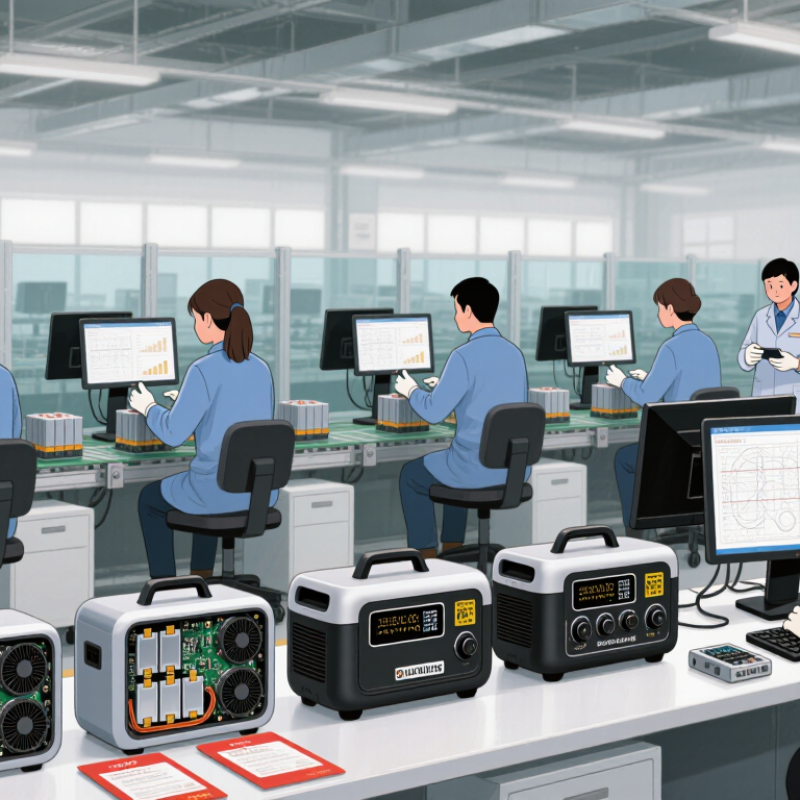
China Top Portable Power Station Suppliers?

What Makes a Portable Power Station Supplier Top-Ranked in China

What Makes a Portable Power Station Supplier Top-Ranked in China

A top-ranked supplier offers more than a low factory quotation. Grand View Research reported that the global portable power station market reached about USD 545 million in 2023. It also projects strong growth through 2030. This demand raises the value of stable engineering and dependable production.

A capable supplier should provide clear battery test records, traceable cells, and inspection reports for every shipment. Ask for protection data covering overcharge, overheating, short circuits, and abnormal temperature changes. IEC 62133-2 and UN 38.3 testing are important reference points for lithium battery products. Local compliance evidence also matters, including applicable Chinese GB standards.

Look closely at the factory process. Can workers explain why a cooling fan starts at a certain temperature? Can the supplier show load-testing records from real production units? A useful audit should include sample testing, not only a polished showroom. Small details expose quality gaps. Loose handles, uneven screens, or unstable inverter output deserve attention.

China Energy Storage Alliance reports continued expansion in battery manufacturing capacity, but capacity alone does not guarantee consistency. Some suppliers still depend heavily on subcontractors. That can complicate traceability and after-sales service. A stronger partner assigns technical staff, documents firmware changes, and keeps replacement parts available. Response time should be tested before purchase. Send a difficult technical question. The answer may reveal more than a sales presentation. I would not treat any single certificate as final proof. Field reliability remains harder to measure.

Major Types of Portable Power Station Suppliers in China

China’s portable power station supply base is not one uniform factory market. It includes OEM/ODM manufacturers, battery-pack specialists, outdoor electronics producers, and trading companies. The categories overlap. That matters when comparing suppliers.

Fortune Business Insights estimates the global portable power station market reached about US$545 million in 2023 and may grow at 8.29% annually through 2032. This growth is pushing buyers toward clearer supplier specialization.

OEM/ODM factories suit customized housings, displays, firmware, and packaging. They coordinate cells, inverters, thermal controls, and final assembly.

Battery-pack specialists focus on cell matching, BMS design, cycle testing, and safety documents.

The International Energy Agency reported that China held roughly 80% of global battery cell production capacity in 2023. That advantage supports scale, but it does not automatically prove finished-product quality.

Trading companies and sourcing integrators can combine several factories. This helps with smaller orders and multilingual communication. However, buyers should verify who controls testing and warranty decisions.

Outdoor electronics manufacturers often understand noise, dust, handles, solar charging, and field use better. Ask for capacity reports, inverter efficiency curves, sample teardown records, and independent test results.

A 1,000-watt label can hide poor surge performance. A factory may excel at cells but struggle with firmware. That is the uncomfortable part. Supplier type is only a starting filter; traceability and after-sales evidence deserve greater weight.

How to Evaluate Chinese Portable Power Station Suppliers

Evaluating Chinese portable power station suppliers starts with evidence, not attractive catalogs. Grand View Research valued the global market at about USD 545 million in 2023. It also forecasts an 8.1% compound annual growth rate through 2030. This growth attracts factories with very different engineering capabilities. The International Energy Agency’s 2024 Global EV Outlook reports that China produced over 75% of global battery cells in 2023. However, strong cell access does not guarantee a reliable finished product.

Request batch-level cell records, BMS logs, cycle-test curves, and protection-board specifications. Ask for samples from regular production, not specially prepared engineering units. Test continuous output with a resistive load for two hours. Check AC waveform stability, USB-C charging negotiation, fan noise, restart behavior, and recharge time. Confirm capacity through delivered watt-hours, rather than printed milliamp-hours. For export readiness, verify applicable IEC 62133-2, UN 38.3, and regional compliance documents. The certificate holder should match the legal manufacturer.

Supplier stability also requires warranty terms, spare-part availability, firmware control, and response records. Review several production batches when possible. A factory refusing traceability deserves caution. My own mistake was trusting a perfect sample; later, fan calibration varied between batches. That small difference affected noise and thermal performance. Market forecasts help. Factory evidence matters more. Numbers can mislead.

China Top Portable Power Station Suppliers? - How to Evaluate Chinese Portable Power Station Suppliers

Evaluation Dimension Recommended Benchmark Why It Matters Documents or Evidence to Request Suggested Weight
Battery Chemistry Lithium iron phosphate (LiFePO₄/LFP) for products prioritizing safety and cycle life. LFP batteries generally provide stronger thermal stability and longer cycle-life potential than conventional lithium nickel-manganese-cobalt chemistries. Battery cell specification, UN 38.3 test summary, material safety documentation, and cycle-life test conditions. 15%
Usable Battery Capacity Require measured watt-hours in addition to nominal capacity; verify the test result at a stated load and ambient temperature. Nominal battery capacity does not equal energy available at the output because conversion losses and reserve limits reduce usable energy. Independent capacity test report showing input energy, output energy, load level, temperature, and cutoff voltage. 12%
AC Output Performance Pure sine-wave output, stable rated wattage, and clearly stated surge capacity with protection against overload and short circuit. Pure sine-wave output is more suitable for sensitive electronics, motors, compressors, and equipment with active power-factor correction. AC waveform report, continuous-load test, surge test, output-voltage tolerance, and protection-function test records. 15%
Charging Speed Specify charging time from 0% to 80% and 0% to 100%; assess AC, solar, vehicle, and USB-C charging separately. Charging time depends on battery size, input power, thermal limits, and the final charging stage, so a single “fast charging” claim is insufficient. Charging curve, input-power measurements, thermal test results, and charger specifications. 10%
Safety and Compliance Products should be supported by applicable transport, electrical-safety, electromagnetic-compatibility, and market-specific compliance documentation. Compliance requirements vary by destination market. Correct documentation reduces customs, insurance, and product-liability risks. UN 38.3, IEC or regional safety reports, EMC reports, CE or UKCA documentation where applicable, and factory quality certificates. 18%
Quality-Control System Incoming-cell inspection, production traceability, aging tests, final functional testing, and documented nonconformance procedures. A documented quality system helps control cell variation, assembly defects, firmware problems, and shipment consistency. Factory audit report, inspection checklist, sample production records, defect-rate data, and corrective-action reports. 12%
Customization Capability Confirm available options for casing, logo placement, packaging, firmware language, outlets, accessories, and regional plug standards. Customization affects tooling, certification, minimum order quantity, lead time, and after-sales complexity. Technical drawings, approved artwork, customization quotation, sample approval process, and tooling ownership terms. 8%
MOQ and Lead Time Request separate schedules for standard products, customized products, sample orders, and repeat production. Actual delivery performance is influenced by battery availability, certification status, packaging approval, and production capacity. Written quotation, production schedule, historical on-time delivery data, and sample-to-mass-production timeline. 7%
Warranty and After-Sales Support Require clearly defined warranty duration, exclusions, repair or replacement procedures, spare-parts support, and response-time targets. Portable power stations combine battery, inverter, charger, display, and software systems; effective support reduces total ownership cost. Warranty policy, RMA workflow, spare-parts list, troubleshooting guide, service-level agreement, and escalation contacts. 8%
Supplier Verification Verify business registration, manufacturing location, export experience, production capability, and consistency between documents and physical facilities. A supplier may be a manufacturer, trading company, or hybrid organization. Verification clarifies accountability and supply-chain control. Business license, factory audit, production-line photographs or inspection, export references, and third-party verification report. 15%
Total Evaluation Weight 100%
Recommended Evaluation Method: Score each dimension from 1 to 5, multiply the score by the suggested weight, and validate all critical claims through samples, factory audits, independent testing, and destination-market compliance checks.

Product Capabilities and Manufacturing Strengths of Leading Suppliers

China Top Portable Power Station Suppliers?

China’s leading portable power station suppliers compete through engineering depth, not only low pricing. Grand View Research estimates the global market reached about USD 545 million in 2023. It also projects a 17.4% compound annual growth rate through 2030. This growth is pushing factories to improve battery safety, inverter efficiency, and production consistency.

Product capability starts with cell selection and battery management. Strong suppliers commonly use lithium iron phosphate cells for longer cycle life and improved thermal stability.

Better factories test each battery pack, inverter board, and charging port separately. They also verify performance under heat, cold, overload, and repeated charging conditions.

IEC 62133-2 and UN 38.3 testing remain important reference points for international shipments. Documentation matters.

Manufacturing strength appears in less visible details.

Automated welding, barcode traceability, and aging tests can reduce early failures. A capable supplier should provide capacity curves, noise readings, charging-time records, and protection data.

MarketsandMarkets expects the portable power station sector to expand strongly this decade, but forecasts vary by research method. That uncertainty deserves attention. Not every impressive specification reflects field performance.

Buyers should request samples from different production batches, inspect corrective-action records, and compare measured output with advertised capacity. The weak point is often quality consistency.

Sourcing, Certification, and Partnership Considerations

Choosing a portable power station supplier in China requires more than comparing wattage and prices. Start with a documented sourcing process. Ask for factory registration, production capacity, battery cell traceability, and recent quality records. Request samples from the same line used for mass production. A polished sample can hide weak consistency. This matters. Check enclosure fit, cable labels, fan noise, display accuracy, and charging behavior under load. Use an independent laboratory when test results seem incomplete.

Certification should match destination markets and product configuration. Review applicable safety, electromagnetic compatibility, transport, and environmental requirements with a qualified compliance specialist. Do not accept a certificate without checking model numbers, test scope, issuing laboratory, and validity. Battery documentation deserves close attention, including protection design, abuse testing, and shipment records. Requirements change, and suppliers may overlook a revised standard. That gap can delay customs clearance or trigger costly redesigns. A simple document checklist often reveals more than a sales presentation.

A reliable partnership depends on transparent communication after the purchase order. Agree in writing on inspection stages, defect limits, spare parts, firmware control, warranty handling, and response times. Ask how the supplier manages a failed batch. The answer is revealing. Factory visits can help, but they are not proof of long-term reliability. Keep third-party inspections and retain production samples for comparison. Forecasts should be shared carefully, since sudden changes strain capacity. A small pilot order is my preferred approach before a larger commitment, though it can slow market entry. That tradeoff deserves honest review.

China Top Portable Power Station Suppliers? — Sourcing, Certification, and Partnership Considerations

Electrical output requirements vary by destination. Buyers should confirm the target market’s nominal voltage and frequency with suppliers before finalizing inverter design, sockets, firmware, labeling, and compliance testing.

Voltage compatibility

A supplier should provide the correct inverter, outlet format, and protection design for each destination market.

Certification planning

Common documentation may include UN 38.3 transport testing, IEC 62133-2 battery safety evidence, EMC testing, and market-specific approvals.

Partnership evaluation

Assess cell traceability, quality-control records, after-sales support, firmware capability, sample consistency, and willingness to support independent testing.

Company Info

Universal Pumping

625 Apache Trail
Woodstock, GA 30189

Mon - Fri | 9:00 AM - 5:00 PM

Connect With Us

About Universal Pumping

Universal Pumping is staffed with industry professionals with 20-45 years experience with high pressure pumping systems. We represent only the “elite producers” in pump manufacturing: Britain’s EMS and Germany’s EMMERICH. Our engineering and manufacturing approach is conservative, and we do not use “guess work” in the design or sales of our pumping and filtration equipment.